AuthorAZ Independent Research | Survey conducted 25 September – 9 October 2026
Indie Authors and AI: Use, Disclosure and Fear (2026)
Published 21 October 2026
Headline findings
75%
21 of 28
selected “Mark heavily edited AI drafts as human-created” as how they complete retailer AI-disclosure forms.
Respondents who selected AI prose drafting as their current use
95%
73 of 77
expect generative AI to have a negative effect on indie-author income over the next three to five years.
Current generative AI users
97%
74 of 76
agreed (4 or 5 on a 5-point scale) that fear of criticism or boycotts makes them keep their AI use private.
Current generative AI users who answered
About this survey. This exploratory survey reflects 107 self-selected respondents. Results describe this sample and should not be generalized to the wider indie-author population.
Executive summary
Of the 107 independent authors who answered this survey, 77 currently use generative AI in some part of their work: 34 for planning and editorial feedback, 28 for drafting prose and 15 for business tasks only. Another 16 tried it and stopped, and 14 have never used it.
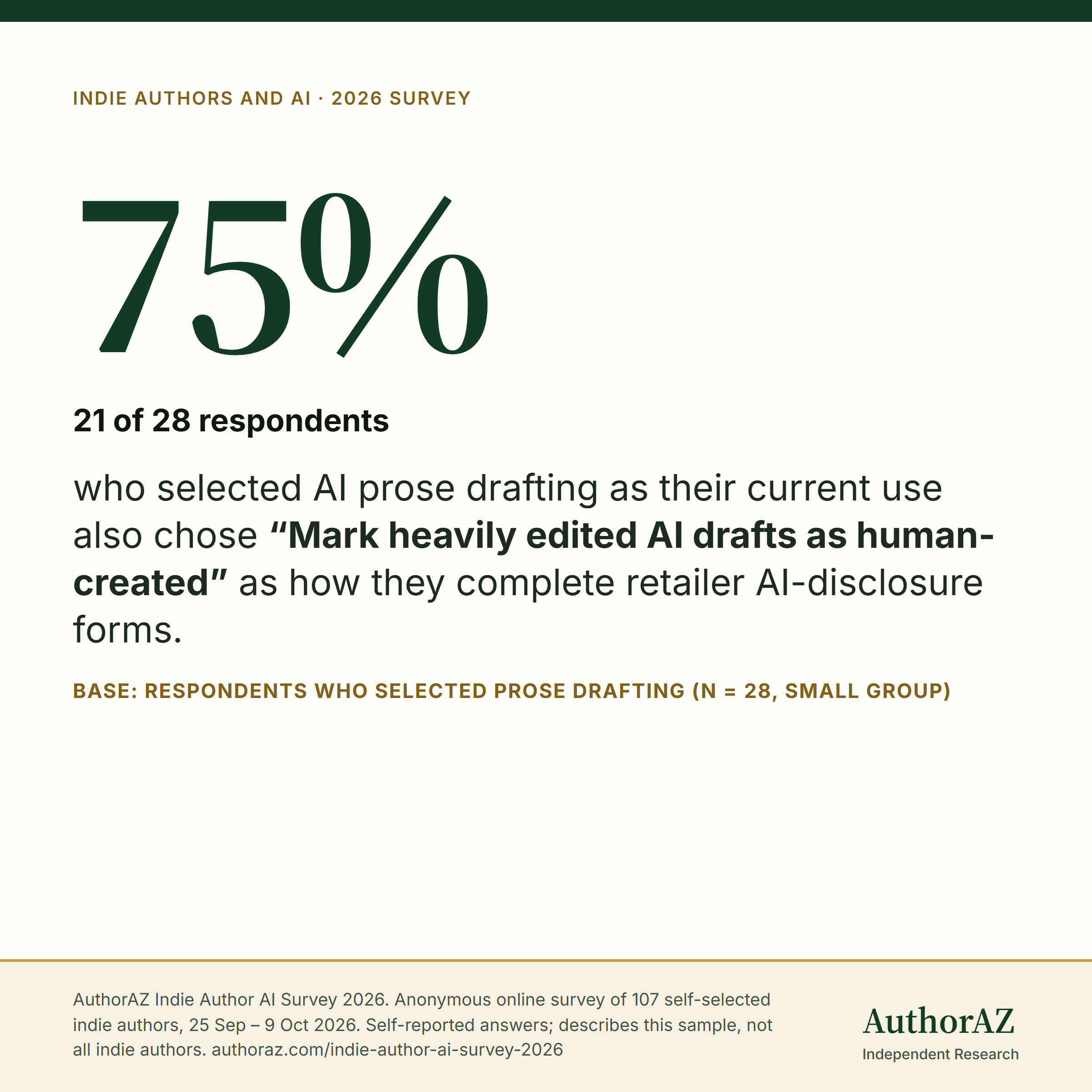
The clearest pattern is a gap between private use and public disclosure. Among the 77 current users, 39 (51%) said they complete retailer AI-disclosure forms by marking heavily edited AI drafts as human-created. Among the 28 who selected prose drafting as their main use, it was 21 of 28 (75%). Telling readers is rarer: 43 of 77 current users (56%) never tell readers when generative AI was used creatively or editorially, and 3 always do. Nearly all current users who answered, 74 of 76 (97%), agreed that fear of criticism or boycotts makes them keep their AI use private.
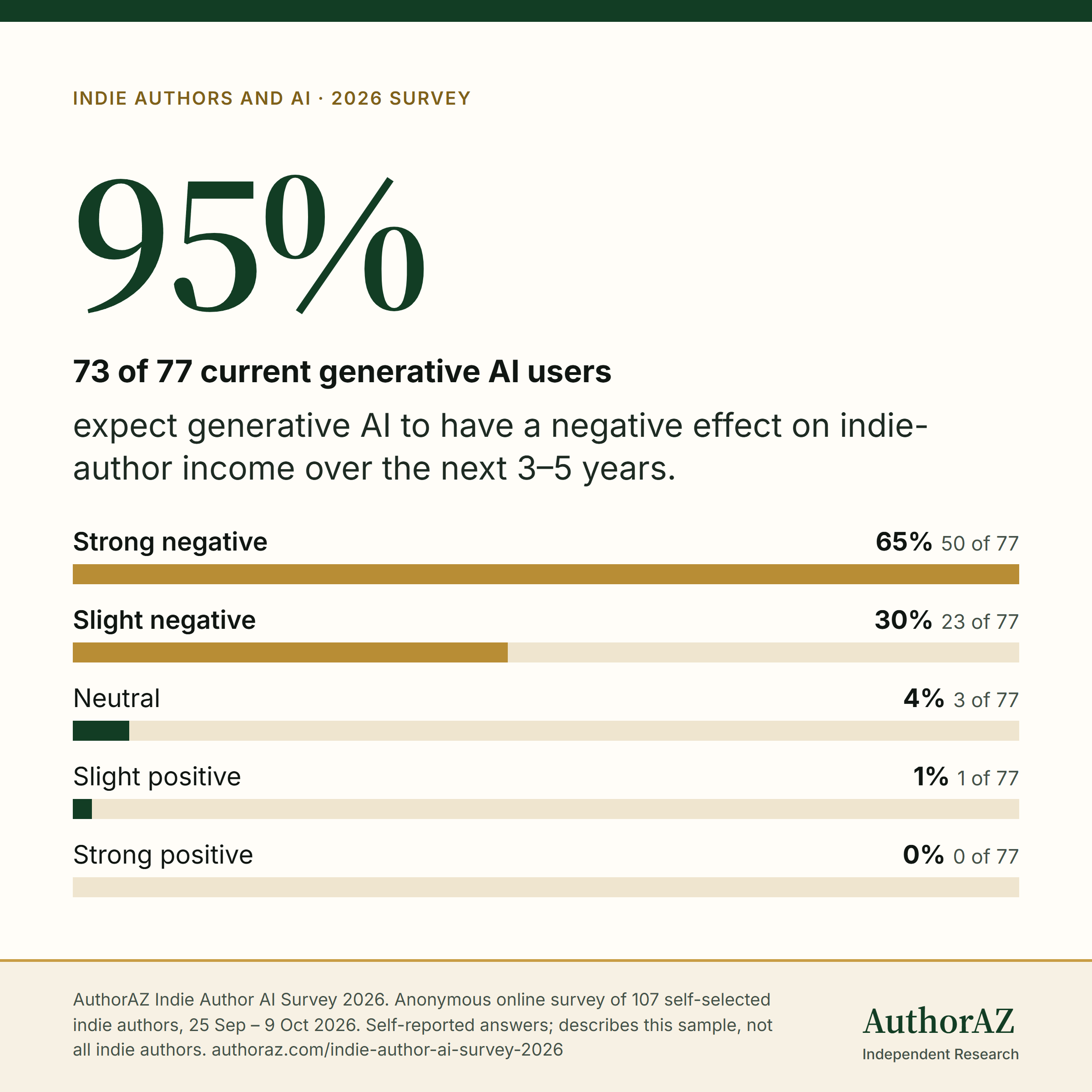
Using the technology does not mean expecting it to pay. 73 of 77 current users (95%) expect generative AI to reduce indie-author income over the next three to five years, close to the 103 of 107 (96%) across all respondents.
These are self-reported answers from a self-selected sample. They describe the authors who took part, and they show which answers occur together, not why.
Who uses generative AI?
Respondents chose the one category that best described their current use. The report counts the first three below as current generative AI users (77 of 107).
Figure 1. Current generative AI use (all respondents, n = 107)
- Planning, structural feedback, or editorial diagnosis32%34 of 107
- Drafting prose, scenes, or line-level text26%28 of 107
- Business/marketing/admin only14%15 of 107
- Tried, then stopped15%16 of 107
- Never used; no intention13%14 of 107
Show the data as a table
| Category | Respondents | Share |
|---|---|---|
| Drafting prose, scenes, or line-level text | 28 | 26.2% |
| Planning, structural feedback, or editorial diagnosis | 34 | 31.8% |
| Business/marketing/admin only | 15 | 14.0% |
| Tried, then stopped | 16 | 15.0% |
| Never used; no intention | 14 | 13.1% |
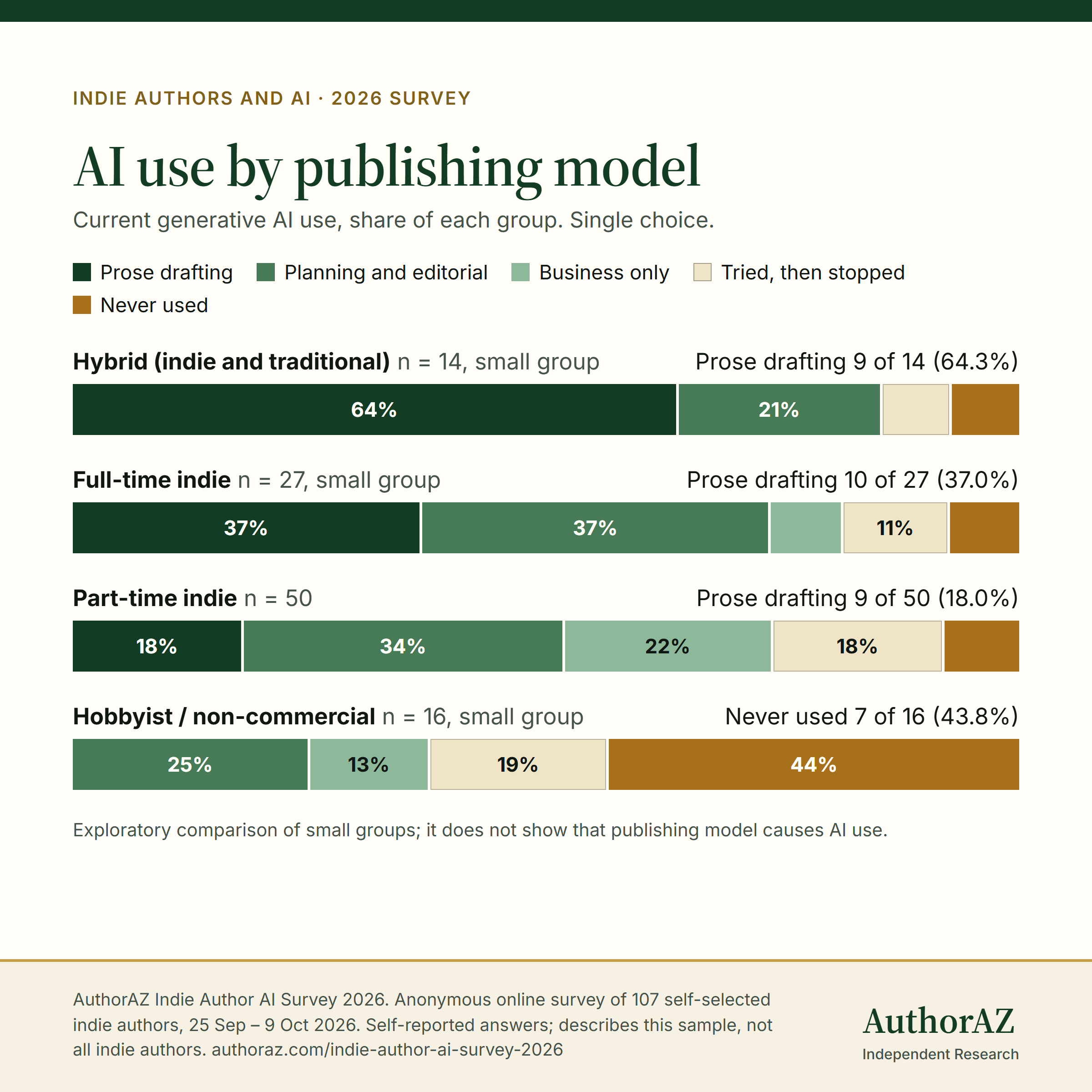
Figure 2. Current AI use by publishing model (share of each group)
- Prose drafting
- Planning and editorial
- Business only
- Tried, then stopped
- Never used
Hybrid (indie and traditional) (n = 14, small group)Prose drafting: 9 of 14 (64.3%)
Full-time indie (n = 27, small group)Prose drafting: 10 of 27 (37.0%)
Part-time indie (n = 50)Prose drafting: 9 of 50 (18.0%)
Hobbyist / non-commercial (n = 16, small group)Never used: 7 of 16 (43.8%)
Show the data as a table
| Publishing model | n | Prose drafting | Planning and editorial | Business only | Tried, then stopped | Never used |
|---|---|---|---|---|---|---|
| Hybrid (indie and traditional) | 14 | 9 (64%) | 3 (21%) | 0 (0%) | 1 (7%) | 1 (7%) |
| Full-time indie | 27 | 10 (37%) | 10 (37%) | 2 (7%) | 3 (11%) | 2 (7%) |
| Part-time indie | 50 | 9 (18%) | 17 (34%) | 11 (22%) | 9 (18%) | 4 (8%) |
| Hobbyist / non-commercial | 16 | 0 (0%) | 4 (25%) | 2 (13%) | 3 (19%) | 7 (44%) |
Prose drafting was most common among hybrid authors (9 of 14, 64.3%), followed by full-time indie authors (10 of 27, 37.0%) and part-time indie authors (9 of 50, 18.0%). Hobbyists were the group most likely to have never used generative AI (7 of 16, 43.8%).
By genre, 13 of 32 romance respondents (40.6%) selected prose drafting, compared with 15 of 75 respondents in all other genres combined (20.0%). Romance authors are over-represented in the sample (see methodology), and this comparison is exploratory.
The disclosure gap
The survey asked two separate disclosure questions with different audiences. One asked how authors complete the retailer AI-disclosure forms that platforms such as Amazon KDP present at publication. The other asked whether they tell readers when generative AI was used creatively or editorially, which no retailer form covers. The answers below come from the 77 current generative AI users.
| Current generative AI users who… | Count | Share |
|---|---|---|
| Selected “Mark heavily edited AI drafts as human-created” (retailer forms) | 39 of 77 | 51% |
| Never tell readers about creative or editorial AI use | 43 of 77 | 56% |
| Always tell readers about such use | 3 of 77 | 4% |
| Agree that fear of criticism or boycotts makes them keep AI use private (4 or 5 of 5) | 74 of 76 | 97% |
Figure 3. How current users complete retailer AI-disclosure forms (n = 77)
- Mark heavily edited AI drafts as human-created51%39 of 77
- Avoid retailers requiring disclosure25%19 of 77
- Declare only retained AI text/art16%12 of 77
- Declare all AI use9%7 of 77
Show the data as a table
| Answer | Count | Share |
|---|---|---|
| Declare all AI use | 7 | 9.1% |
| Declare only retained AI text/art | 12 | 15.6% |
| Mark heavily edited AI drafts as human-created | 39 | 50.6% |
| Avoid retailers requiring disclosure | 19 | 24.7% |
Figure 4. Whether current users tell readers about AI use (n = 77)
- Never56%43 of 77
- Only if required by a platform31%24 of 77
- Case by case9%7 of 77
- Always4%3 of 77
Show the data as a table
| Answer | Count | Share |
|---|---|---|
| Always | 3 | 3.9% |
| Only if required by a platform | 24 | 31.2% |
| Case-by-case when generated text reaches the final draft | 7 | 9.1% |
| Never | 43 | 55.8% |
Respondents who draft prose with AI
28 respondents selected “Drafting prose, scenes, or line-level text” as their current use of generative AI. This is a small group, so treat the shares as indicative.
75%
21 of 28
selected “Mark heavily edited AI drafts as human-created” for retailer disclosure forms.
Prose drafters
64%
18 of 28
say they never tell readers when generative AI was used.
Prose drafters
93%
26 of 28
chose the strongest agreement, 5 of 5, that they keep AI use private for fear of criticism or boycotts.
Prose drafters
What authors use AI for
All respondents rated how often they use AI for fourteen tasks. Support work leads: 97 of 102 (95.1%) reported frequent or occasional AI-assisted copyediting or proofreading, and the same number used it for category, keyword or market research. Blurbs and synopses (88 of 102, 86.3%) and ad copy (87 of 102, 85.3%) follow.
Creative tasks divide respondents more sharply. The chart separates two kinds of non-use: Never records that a respondent does not use AI for the task; Will never consider records an explicit refusal. For full-scene or chapter drafting, 35 of 102 chose “Will never consider”, while 46 of 102 reported some use.
Figure 5. How often respondents use AI, by task (all respondents who answered each row)
- Frequently
- Occasionally
- Never
- Will never consider
Manuscript workflow
Copyediting/proofreadingUse: 97 of 102 (95%)
OutliningUse: 84 of 102 (82%)
Pacing/plot/timeline diagnosisUse: 79 of 102 (77%)
WorldbuildingUse: 52 of 101 (51%)
Full-scene/chapter draftingUse: 46 of 102 (45%)
Scene transitions/hooksUse: 39 of 102 (38%)
Dialogue/dialectUse: 33 of 101 (33%)
Sensory/setting descriptionUse: 33 of 101 (33%)
Publishing and packaging workflow
Category/keyword/market researchUse: 97 of 102 (95%)
Blurbs/synopsesUse: 88 of 102 (86%)
Ad copyUse: 87 of 102 (85%)
Newsletters/social postsUse: 52 of 102 (51%)
Retail cover artUse: 40 of 102 (39%)
Retail audiobooksUse: 21 of 102 (21%)
Show the data as a table
| Task | Frequently | Occasionally | Never | Will never consider | n |
|---|---|---|---|---|---|
| Copyediting/proofreading | 65 (64%) | 32 (31%) | 3 (3%) | 2 (2%) | 102 |
| Category/keyword/market research | 58 (57%) | 39 (38%) | 1 (1%) | 4 (4%) | 102 |
| Blurbs/synopses | 48 (47%) | 40 (39%) | 9 (9%) | 5 (5%) | 102 |
| Ad copy | 37 (36%) | 50 (49%) | 9 (9%) | 6 (6%) | 102 |
| Outlining | 38 (37%) | 46 (45%) | 5 (5%) | 13 (13%) | 102 |
| Pacing/plot/timeline diagnosis | 37 (36%) | 42 (41%) | 10 (10%) | 13 (13%) | 102 |
| Worldbuilding | 11 (11%) | 41 (41%) | 24 (24%) | 25 (25%) | 101 |
| Newsletters/social posts | 16 (16%) | 36 (35%) | 38 (37%) | 12 (12%) | 102 |
| Full-scene/chapter drafting | 6 (6%) | 40 (39%) | 21 (21%) | 35 (34%) | 102 |
| Retail cover art | 10 (10%) | 30 (29%) | 26 (25%) | 36 (35%) | 102 |
| Scene transitions/hooks | 9 (9%) | 30 (29%) | 31 (30%) | 32 (31%) | 102 |
| Dialogue/dialect | 6 (6%) | 27 (27%) | 32 (32%) | 36 (36%) | 101 |
| Sensory/setting description | 6 (6%) | 27 (27%) | 33 (33%) | 35 (35%) | 101 |
| Retail audiobooks | 7 (7%) | 14 (14%) | 43 (42%) | 38 (37%) | 102 |
The economic paradox
Respondents who use generative AI are almost as pessimistic about its effect on their income as those who do not. The survey cannot say whether users adopted AI despite expecting this, or because of it.
95%
73 of 77 current AI users
expect generative AI to have a negative net effect on indie-author income over the next three to five years.
All respondents: 103 of 107 (96.3%).
Figure 6. Expected net effect on indie-author income, next 3–5 years (current AI users, n = 77)
- Strong negative65%50 of 77
- Slight negative30%23 of 77
- Neutral4%3 of 77
- Slight positive1%1 of 77
- Strong positive0%0 of 77
Show the data as a table
| Answer | Current users | All respondents |
|---|---|---|
| Strong negative | 50 (65%) | 78 (73%) |
| Slight negative | 23 (30%) | 25 (23%) |
| Neutral | 3 (4%) | 3 (3%) |
| Slight positive | 1 (1%) | 1 (1%) |
| Strong positive | 0 (0%) | 0 (0%) |
Figure 7. Top concerns about generative AI in commercial publishing (all respondents who answered, n = 105)
- Reader distrust of self-publishing95.2%100 of 105
- Marketplace flooding and discoverability74.3%78 of 105
- Privacy and manuscript leakage60.0%63 of 105
- Unconsented copyrighted training data48.6%51 of 105
- Subscription-pool devaluation14.3%15 of 105
- Loss of craft, voice or depth14.3%15 of 105
- No major concerns1.0%1 of 105
Show the data as a table
| Concern | Respondents | Share |
|---|---|---|
| Reader distrust of self-publishing | 100 | 95.2% |
| Marketplace flooding and discoverability | 78 | 74.3% |
| Privacy and manuscript leakage | 63 | 60.0% |
| Unconsented copyrighted training data | 51 | 48.6% |
| Subscription-pool devaluation | 15 | 14.3% |
| Loss of craft, voice or depth | 15 | 14.3% |
| No major concerns | 1 | 1.0% |
Respondents and methodology
Publishing model (n = 107)
- Full-time indie (primary income)25%27 of 107
- Part-time indie (supplemental income)47%50 of 107
- Hobbyist/non-commercial indie15%16 of 107
- Hybrid (indie and traditional)13%14 of 107
Show the data as a table
| Answer | Respondents | Share |
|---|---|---|
| Full-time indie (primary income) | 27 | 25.2% |
| Part-time indie (supplemental income) | 50 | 46.7% |
| Hobbyist/non-commercial indie | 16 | 15.0% |
| Hybrid (indie and traditional) | 14 | 13.1% |
Primary genre (n = 107)
- Romance30%32 of 107
- Sci-Fi/Fantasy14%15 of 107
- Mystery/Thriller/Crime11%12 of 107
- Horror/Dark Fiction9%10 of 107
- Literary/Contemporary13%14 of 107
- Non-Fiction/Memoir12%13 of 107
- YA/Middle Grade10%11 of 107
Show the data as a table
| Answer | Respondents | Share |
|---|---|---|
| Romance | 32 | 29.9% |
| Sci-Fi/Fantasy | 15 | 14.0% |
| Mystery/Thriller/Crime | 12 | 11.2% |
| Horror/Dark Fiction | 10 | 9.3% |
| Literary/Contemporary | 14 | 13.1% |
| Non-Fiction/Memoir | 13 | 12.1% |
| YA/Middle Grade | 11 | 10.3% |
| Other | 0 | 0.0% |
Published titles (n = 107)
- 0 (pre-publication)15%16 of 107
- 1 to 336%38 of 107
- 4 to 936%38 of 107
- 10 to 2414%15 of 107
Show the data as a table
| Answer | Respondents | Share |
|---|---|---|
| 0 (pre-publication) | 16 | 15.0% |
| 1 to 3 | 38 | 35.5% |
| 4 to 9 | 38 | 35.5% |
| 10 to 24 | 15 | 14.0% |
| 25+ | 0 | 0.0% |
Net author revenue, past 12 months (USD) (n = 107)
- Under $1,00012%13 of 107
- $1,000–9,99916%17 of 107
- $10,000–49,99921%23 of 107
- $50,000–99,99924%26 of 107
- $100,000–249,9994%4 of 107
- Prefer not to disclose22%24 of 107
Show the data as a table
| Answer | Respondents | Share |
|---|---|---|
| Under $1,000 | 13 | 12.1% |
| $1,000–9,999 | 17 | 15.9% |
| $10,000–49,999 | 23 | 21.5% |
| $50,000–99,999 | 26 | 24.3% |
| $100,000–249,999 | 4 | 3.7% |
| $250,000 or more | 0 | 0.0% |
| Prefer not to disclose | 24 | 22.4% |
How the survey was run
- 107 self-identified indie authors took part. Fieldwork ran from 25 September 2026 to 9 October 2026.
- Respondents were recruited through the AuthorAZ newsletter and BookTok posts on TikTok. That channel mix is a likely reason romance authors make up 32 of 107 respondents.
- Participation was self-selected, not random. The survey is not statistically representative of the wider indie-author population, and no margin of sampling error is given because one cannot be calculated for a sample of this kind.
- The questionnaire ran on Google Forms and was anonymous: it asked for no names, email addresses or other contact details, and the dataset contains none. Repeat submissions were limited to one response per IP address. That limits submissions per network connection; it does not verify individual identities, so a person using more than one connection could have answered twice.
- Answers are self-reported and were not independently verified.
- Percentages use the number of people who answered each question, which varies because some respondents skipped questions. Each figure states its base.
- “Current generative AI users” (77) are respondents who chose planning and editorial feedback, prose drafting, or business tasks only as their current use.
- Subgroup comparisons, by publishing model, genre or type of use, are exploratory and several groups are small. They show differences in this sample, not causes.
- AuthorAZ is an independent resource for self-published authors and also makes an offline writing app that does not use AI.
Data and questionnaire
The full questionnaire and aggregate tables for every question are available below. The tables give each answer’s count, base and percentage for all respondents and for the subgroups used in this report. Respondent-level records are not published: with 107 respondents, combinations of genre, publishing model, title count and revenue could identify individuals.
For journalists
- Report
- Indie Authors and AI: Use, Disclosure and Fear (2026). AuthorAZ Independent Research. Fieldwork 25 September 2026 – 9 October 2026.
- Headline findings
- 21 of 28 respondents who selected AI prose drafting as their current use (75%) also selected “Mark heavily edited AI drafts as human-created” for retailer disclosure forms.
- 73 of 77 current generative AI users (95%) expect a negative effect on indie-author income over the next three to five years.
- 74 of 76 current users who answered (97%) agreed that fear of criticism or boycotts makes them keep their AI use private.
- Method
- Anonymous online survey of 107 self-identified indie authors, recruited through the AuthorAZ newsletter and BookTok. Self-selected, not representative; self-reported answers; bases vary by question. Please describe results as “among respondents” or “in this survey”.
- Downloads
- Questionnaire (PDF)
- Aggregate tables (CSV)
- Chart: Retailer disclosure among prose drafters (75%) (PNG, 2400 px)
- Chart: Income outlook among current AI users (95%) (PNG, 2400 px)
- Chart: AI use by publishing model (PNG, 2400 px)
Charts may be reused with credit to “AuthorAZ Indie Author AI Survey 2026” and a link to this page.
- Contact
- team@authoraz.com